Dukascopy/JForex data
Historical source data enters a date-range-aware acquisition workflow.
 PRIVATE BETA ↗
Technology
TickArk treats tick history as a repository with observable state—not as an anonymous file. Acquisition, verification, targeted recovery, normalization and export form one traceable workflow.
END-TO-END WORKFLOW
Each stage answers a different operational question: what is available, what is local, what is incomplete, what can be recovered and what is ready to export.
Historical source data enters a date-range-aware acquisition workflow.
Selected instruments and periods are downloaded or updated into a UTC-based local repository.
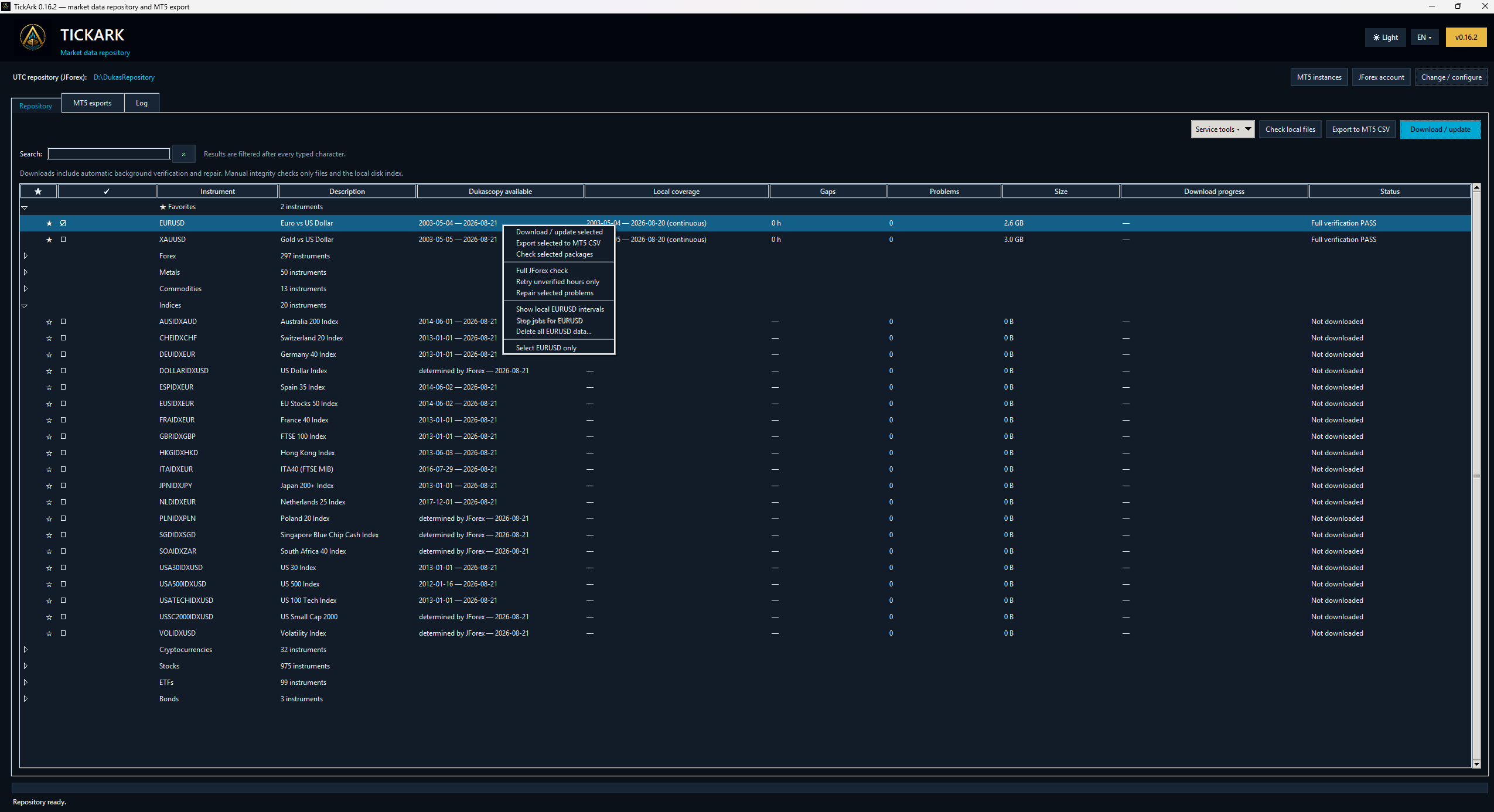
Source availability, local coverage, gaps, package state and detected problems remain visible.
Unverified hours and selected recoverable problems can be retried without blindly replacing the repository.
Source records are prepared in a consistent internal representation for downstream processing.
Verified repository data is mapped and packaged for supported platform workflows.
Broker-aware export preparation is available in the current product.
Explore the MT5 workflow ↗MT4 export is a future target and is not currently available.
See platform status ↗Compare source availability with local coverage, data size, gap duration, problem counts and current verification status before taking action.
Verification is designed to surface detectable gaps and repository problems before the data is sent into a research or backtesting workflow.
Retry unverified hours or selected problems against known date ranges. Keep valid history outside the chosen operation in place.
VERIFICATION IN PRACTICE
The repository exposes a full JForex check, targeted retries for unverified hours and repair actions for selected problems. Local intervals and active jobs can be inspected from the same workspace.
Integrity checks identify detectable acquisition and repository issues. They do not guarantee future performance or the economic validity of any trading model.
WHY THE PIPELINE MATTERS
Long date ranges contain many smaller retrieval units. Network interruptions, unavailable source periods or incomplete packages can leave a repository looking present while still requiring attention.
TickArk keeps source availability and local coverage visible together. That distinction helps separate a missing local interval from a period that is not available from the source.
Normalization and platform mapping are downstream steps. The repository remains the controlled foundation, so the same verified history can support evolving export targets.
PRIVATE BETA
Join the private beta interest list. Share the instruments and workflow that matter to you, and we'll contact you when a suitable opportunity becomes available.
Join the Private Beta ↗